Showing posts with label Family History. Show all posts

Saturday, April 9, 2022

Three Newspaper Brothers All Die Young

 Three brothers, sons of Orlando Erastus Chamberlain and Mary Cram, all became newspaper men. These three, Ernest Orlando Chamberlain (1859-1898), Wilbur Johnson Chamberlain (1866-1901), and Walter N. Chamberlain (1869-1900) are my first cousins, three times removed. They all died between 1898 and 1901. Ernest had reached the pinnacle of his profession as managing editor of the New York Evening World working for Joseph Pulitzer, but the pressures of work then seemed to affect his health, and he finally succumbed to pneumonia at the age of 38. Wilbur and Walter likewise had health problems and died at 37 and 30 years of age respectively. Only Wilbur had surviving children. Here are newspaper notices about them.

[The Philadelphia Enquirer, Thursday, 8 January 1885, page 8] Elizabeth, N.J. -- The libel suit of ex-mayor L.V.F. Randolph, of Plainfield, against ERNEST O. CHAMBERLAIN, formerly editor of the Plainfield Bulletin, for $20,000 was tried yesterday. The jury returned a verdict for six cents.

[New York Herald, Tuesday, 19 April 1898, p. 13]
ERNEST O. CHAMBERLAIN, managing editor of the Evening World, died last night of pneumonia at his home, Rockledge, at Edgewater on the Hudson. Although Mr. Chamberlain had been ill for a month, his death came as a shock to his friends. Reports from his home told that he was improving, and that he would return to his place in the field of newspaper work after a period of rest. Mr. Chamberlain's condition became so alarming on Sunday afternoon that his physicians were hurriedly summoned. He continued to grow worse until the end last night. Mr. Chamberlain was thirty-eight years old and had earned for himself a conspicuous place among the editors and writers of the country. He was born at Great Bend, Pa., in 1860, and received a common school education and began writing for the Great Bend Reporter when quite a young man. He afterward went to Dunellen, N.J., and edited a newspaper called the Rock. Just after attaining his majority, Mr. Chamberlain bought the Plainfield (N.J.) Bulletin. His treatment of the politics of New Jersey resulted in his being called to edit the Trenton Times. Afterward, he went to Philadelphia and became New Jersey editor of the Philadelphia Press. In 1886, Mr. Chamberlain came to New York and was employed on the New York Sun, where he remained until 1892. His principal work was of a political nature. From the Sun he went to the World, becoming the city editor. For five years he had charge of either the morning or evening editions of the World, except during brief periods when he had charge of the gathering or writing of news of special importance. In August 1897, Mr. Chamberlain went to Europe and on his return wrote a series of articles on the government of European cities, which were widely quoted and favorably commented upon. Mrs. Chamberlain survives her husband. Two of his brothers are newspaper men.

[Batavia Daily News, Thursday, 21 April 1898, page 2] ERNEST O. CHAMBERLAIN, news editor of the New York Evening World collapsed a few weeks ago from overwork getting out extra after extra of the yellow journal. He became crazy, and his death occurred this week.

 W. J. CHAMBERLAIN DIED AT CARLSBAD -- New York, Aug. 15 -- Word has reached here from Carlsbad, telling of the death of W.J. Chamberlain, one of the best American newspaper men. His death occurred yesterday. Death was due to cerebral congestion and heart failure. Chamberlain was born in Great Bend, Pa., on March 12, 1866. He did his first newspaper work in Jersey City and joined the staff of the New York Sun in 1890. He continued in the services of the paper until his death. He had a part in the most important news getting exploits of his day. His story of the fight at Santiago during the Spanish-American War caused widespread comment. When war broke out in China, Chamberlain was sent there. Illness forced him to return to London some weeks ago. [The Buffalo Enquirer, Buffalo, New York, Thursday, August 15, 1901, page 8]

[Philadelphia Enquirer, Wednesday, 18 July 1900, page 4]
Plainfield, N.J., July 17 -- WALTER N. CHAMBERLAIN, who has been engaged in newspaper work in New York for the past ten years, died at his home in this city this morning after an illness lasting about two weeks. Mr. Chamberlain was born in Plainfield 31 years ago, and was a brother of the late Ernest Chamberlain, who was managing editor of the New York World for a time. While engaged in professional work at the burning of the steamship piers in Hoboken June 30 he contracted a cold which caused his death. He was unmarried.
 

Saturday, January 22, 2022

Death of a Young Woman

 My 5th Cousin, 3 times removed, a young girl by the name of Grace Dearborn, came to a tragic end when she tried to obtain an abortion. Here is the story as reported in the Boston Globe.

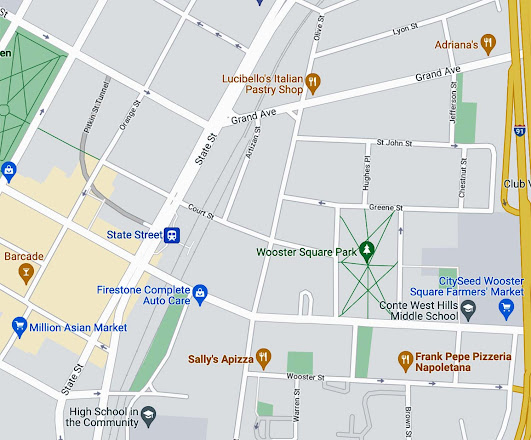
Map of New Haven, Connecticut with Wooster Street near the bottom right and Orange Street diagonally on the upper left. These are the streets mentioned in the article.
 

[The Boston Globe, Sunday, 19 December 1897, page 1]
WAS PRETTY GIRL. Grace Dearborn Died in New Haven. Belonged in Everett and Was a Clerk in Treasurer's Office. Left Home Ostensibly to Attend a Wedding. Was Ill One Week Before Parents Were Informed. Dr. Bond Held Without Bail on a Charge of Murder.

   Dec 18 -- The body of Miss Grace Dearborn, who died in this city yesterday as a result o a criminal operation, was taken to her late home this afternoon by her father, Daniel O. Dearborn, an assessor of Everett, Mass.
   Miss Dearborn died at 1 yesterday afternoon at the house kept by Mrs. Frederick Mathis, at 186 Wooster st. Mrs. Mathis and Miss Dearborn became acquainted last summer at Asbury Park, N.J. Miss Dearborn came here about 7 days ago and told her friend she wanted to stay at her house a while. She visited Dr. Elijah A. Bond, so the authorities say, and he has been arrested by order of Coroner Mix and locked up at police headquarters, charged with murder. The coroner refused to admit him to bail.
   Bond had been in trouble before. About three years ago a young girl complained to the city attorney that he had subjected her to an operation, and he was arrested, but the evidence was insufficient and he was released.
   Miss Dearborn had been sick one week at the boarding house on Wooster st. and shortly before her death Dr. Welch was called, and he summoned Dr. Russell, but it was too late to save her life.
   The girl during her sickness refused to give her name, telling the attendants to call her 'Grace,' and she also refused to give her parents address. Just before her death, however, she gave their address and a telegram was sent to them. Her father reached this city late in the afternoon. He was prostrated over the death of his daughter...
   Miss Dearborn was 24 years old. She had been employed in the office of the city treasurer of Everett, and was a pretty girl, well liked by everybody. Her betrayer, it is said, lives in Everett, and it is rumored that he is an official in that town, but the authorities here, although claiming to know his name, refuse to divulge it at present. Miss Dearborn, when she left home, said she was going to attend the wedding of a friend in New Britain.
   An autopsy was performed on the body of Miss Dearborn this afternoon, and after it was over, medical examiner White reported to Coroner Mix that death was caused by criminal maltreatment.
   The coroner turned the body over to her father, and made the following statement: "This young woman's name was Grace Dearborn. She was 24 years of age and the daughter of Daniel O. Dearborn, on of the assessors of the city of Everett, Mass, three miles from the city of Boston. She was a clerk in the office of the treasurer of Everett. She left home the latter part of last week, and told her parents that she was going to New Britain, this state, to attend the marriage of a friend. Instead of going to New Britain, she came to this city and stopped with friends at 186 Wooster St. In a couple of days she called at the house of Dr. Bond on Orange St. He performed the operation in his own house, and the young woman returned to 186 Wooster st. Mrs. Mathis called in Dr. W. C. Welch. He saw that she was a very sick girl, and it was decided to telegraph her people that she could not live through the day. This was done and her father started at once for this city.
   "Dr. Welch called in Dr. Thomas Russell at 11:30 yesterday morning. He saw that she could not possibly live through the day, and he at once drove to my house. I went with him in his carriage to the Wooster st house, and found the girl to be dying. I took her antemortem statement.
   "I wired her people that she was dying, and she died at 1 in the afternoon, before her father could reach here. I ordered the body removed at once to the morgue, and requested Dr. White to hold an autopsy this morning."
   It seems Miss Dearborn came to this city with a young man whose name the coroner or any one else will not divulge. She tried to be admitted into a maternity hospital in this city, but a physician, who was first consulted, declined to take charge of the case. This is given as the reason why she finally decided to go to the home of the Mathis family on Wooster st. without telling them her plans.


Wednesday, July 26, 2017

Clark Family Wedding and Baptism in Montana

Here are a few of my photos from a family wedding and baptism at my brother-in-law's Montana ranch last week. The ranch sits on the rim of a bench overlooking the Big Hole River near Twin Bridges, Montana.

 Lily and father Ben prior to baptism.

Lily being baptized by her father, Ben Clark, in the Big Hole River.

Sisters Josie, Bridget, and Lily dressed for the wedding.

 Chairs set up for the wedding on the deck of the cabin.

Reverend Jed awaiting the bride and groom.

Flower girls.

The groom and bride after the ceremony.

Chris Clark with his three nieces: Lily and Josie behind Bridget.

 Clark Family: Ben, Chris, Erika, Jed, Steve, Kerstin, and Grandpa David.

Grandmother Stephanie Kovachek.

Josephine (Josie) Clark.

Lily Clark.

Bridget Clark.

Moses Rockwell Crow an Owner of Hollyrood Farm


James Wallick, owner of Hollyrood Stock Farm located near Circleville, Orange County, New York, was in financial trouble in 1897. By July of that year, he was desperate enough to auction off all of the furnishings at Hollyrood, including the carpets, bedroom sets, parlor furniture and other effects, some of which had “never been used.” In August of 1897, he and his wife, Mary McInnes Wallick, sold the Hollyrood farm to Elizabeth H. Crow, wife of Moses Rockwell Crow for $22,000. The sale was for 276 acres and included the lands sold to Delphine Stewart by Emma Parmelee as well as the lands sold to George M. Wilkes by Emma’s brother Robert Hill.  At the time of the sale, the Middletown Daily Argus reported that “the mansion of this farm was erected in 1856 and is one of the handsomest in Orange county and is situated in a beautiful plot of ten acres, surrounded by lovely lawns, beautiful evergreen hedges and imported ornamental trees and shrubbery.” The farm was held by the Crow’s for about six years until 1903 when Elizabeth sold the land back to James H. Wallick after the death of her husband. Who were Moses and Elizabeth Crow? And what is their story?

 Hollyrood Stock Farm

Moses Rockwell Crow was born in September of 1853 in Seneca Falls, Seneca County, New York to the Reverend David Crow and Sarah Burlingame Crow. His father was a graduate of Allegheny College, was fluent in twenty-seven languages, and sought out by scholars due to his knowledge of Sanscrit. During Moses youth the family moved from the Town of Benton in Yates County, to the Village of Ovid in Seneca County, then to Elmira in Chemung County, and finally to New York City. According to an article from the New York Herald, Moses started out as a businessman “in a Pennsylvania town, and, failing there, came back to New York City and entered the New York Law School where he graduated at the head of his class.

He apparently did not spend much time practicing law, but went to Mexico as a consultant to Mexican President Diaz on financing and engineering a system of water works for Mexico City. This trip piqued his interest in water delivery systems and, in order to better understand them, he went to Europe and studied the water supply systems there and “while returning to the United States he became acquainted with a man named I. M. Weston, who was a wealthy lumber merchant from Grand Rapids, Mich. Mr. Weston pointed out the advantages of Grand Rapids as a field for water works exploitation. Mr. Crow bought the Grand Rapids Hydraulic Company, converted its spring into a series of huge wells, put in thirty miles of iron mains and built a pump house and huge standpipe.” The New York Herald story continues by saying that:

“The company thrived for a time, until beset by litigation by the city to oust it and by creditors to collect dues, it went into the hands of a receiver named by Mr. Crow, and this receiver still holds it.
“Mr. Crow then bought the old Mount Vernon Water Company. It was not long before he got into legal difficulties with the firm of Coffin & Stanton, who financed the scheme. Mr. Crow fought the then great concern of Coffin & Stanton, that controlled more than fifty water companies, and ultimately drove it into bankruptcy, to the terror of something like twelve hundred country banks, which had loaned money to the firm and had taken water bonds as collateral.

“Mr. Crow resolved to broaden his field of operations. In 1891 he made a contract with the Village of West Chester to supply it with water, and this was followed by contracts with the Village of Wakefield, Williamsbridge, South Mount Vernon, Pelhamville, Pelham Manor, Barton and City Island, the Morris Park race course, the city of New York for Ward’s Island and the government for the military reservation of Fort Schuyler.

“Most of the money to build the necessary works was supplied by Mrs. M. H. Hotchkiss, widow and heiress of the maker of the Hotchkiss gun. She gave Mr. Crow railway bonds in exchange for bonds of his water companies, and Mr. Crow controlled the companies. Instead of using all the money to pay for building the plant he retained, it was said, much of it as contractor. For construction materials he gave notes of his water companies secured by bonds of the concerns he controlled. The New York and Westchester Water Company was first capitalized with $500,000 in stock and $500,000 in bonds. Soon more money was needed and a second mortgage was issued of a half million dollars.


“Later a prior lien mortgage was made to take preference over the other bonds. Of $1,000,000 prior issue of bonds, $200,000 worth were actually sold, and the Court of Appeals at Albany is expected soon to hand down a decision as to whether they are valid or not.

“More money being needed, Crow organized the New York City District Water Supply Company, with $2,000,000 of stock and $2,000,000 of bonds, many of which he disposed of to Mrs. Hotchkiss. This company’s plant consisted of a single main extending from a point across the Bronx from Wakefleld, known as East Yonkers, to Yonkers proper, a pump house and a standpipe. The original company could have built this, but the scheme was concocted to obtain needed finances. Later Mr. Crow organized, for the same reason, the Upper New York City Water Company, capitalized with $1,000,000 stock and $1,000,000 bonds, which ran a main from the Westchester plant up into the Saw Mill River Valley.

“This main the original company could have laid. Then the promoter bought the Pocantico Water Works Company, having a pump house on Pocantico Lake in Sleepy Hollow, North Tarrytown, and connected his system from that point down the Hudson to the Harlem River, thence across the Twenty-third ward to the East River, thence northeast across City Island, thence under Long Island Sound to Hart’s Island, with more than two hundred miles of mains...

“Mr. Crow [who was still single at the time] in 1892 bought the large house at the corner of Eighty-second street and West End avenue and later added the adjoining property to it. Then he began to spend money in lavish entertainments which attracted much attention. He bought the Hotchkiss estate at Great Barrington, Mass., and spent $100,000 to renovate the house and grounds.

“On Christmas week of 1893 he took a party of guests, by special train, to Great Barrington and entertained them for a week at a cost of $50,000. He bought a steam yacht. One summer he rented the largest on the Hudson and leased one of the largest estates on the New Jersey coast at Elberon for the Winter. He took parties on special cars to Florida, and spent money in reckless fashion. Mrs. Hotchkiss became alarmed and refused to advance any more money.” [New York Herald, Sunday, 12 July 1903, p. 3 & 7]

Perhaps due to prodding from Mrs. Hotchkiss, who was unhappy with the party lifestyle of the man in whom she had entrusted so much of her wealth, or perhaps because of the death of his father in August 1892, Moses Crow decided to settle down in 1893. He had met Louise Doelger, probably at one of his lavish parties. She was young, only twenty years old, and apparently quite pretty––pretty enough to catch the eye of the thirty-nine-year-old bachelor Moses. Louise was the daughter of Jacob Doelger, a well-known and wealthy brewer in New York, and his wife Louise Werner Doelger. It is unclear if the Doelger’s approved of the marriage, but it seems likely that they did. Their daughter was marrying a man of some wealth and influence. The couple was married in Manhattan on the 5th of April and moved into Moses’ house on Eighty-second street. The marriage was actually performed twice due to the religious differences between the families.


"The marriage of Miss Doelger to Mr. Crow was celebrated by the Rev. Madison C. Peters in the rectory of the Bloomingdale Reformed Church...[Mr. Crow] is a Protestant and she a Catholic. A second ceremony was performed a week later at the house of the bride’s father by the Rev. Father Taylor, by special dispensation of Archbishop Cerrigan. After the wedding trip they went to live at No. 301 West Eighty-second street, a large brown-stone house fronting on West End avenue. It is furnished luxuriously throughout." [New York World, Friday, 8 September 1893, p. 7 and New York Herald, Friday, 8 September 1893, p. 10]

However happy they might have been on the 5th of April, by June things had turned sour. On the 16th of June, young Louise left the house with her mother, who was visiting her, and never returned. Her husband returned home that evening to find that she was gone. This was a surprise to him, he claimed, because they had never quarreled and she had given him no indication that she was unhappy. This is likely not the complete truth as Louise’s father seems to have become suspicious of how much money Moses really had and was convinced that it was not nearly as much as he had been led to believe. Three months later the newspapers reported that Moses would not return his wife’s expensive wedding gown and other clothes, supposedly worth $3000. She applied through her lawyers in September to retrieve it and also to appoint her father as her guardian, since she was still not of age. Moses replied that he was not stopping her from retrieving the gown, but that he was not going to send it to her; he professed to be still in love with her and, after all, she was still his wife. She did not remain his wife for much longer, however, as the marriage was dissolved by divorce decree in 1894.


Not long after the divorce was finalized, perhaps even on the very day of the decree in 1894, Moses R. Crow married a second time to Miss Elizabeth Davis who was about six months younger than Moses’ first wife Louise. Elizabeth, born in May 1873 in New York, gave Moses two children: David born in November of 1894 in New York and Lucile born in August of 1896 in New Jersey.

Shortly after the birth of his second child, Moses found himself embroiled in a long and difficult trial. He and his benefactress, Mrs. Maria Hotchkiss, had a falling out over financial matters and Moses sued her, and another financier, Mr. Joseph Richardson, in court for $4,000,000 in securities. Maria, formerly Miss Maria Bissell, was known as a shrewd business woman and had inherited a fortune from her husband, Benjamin Berkeley Hotchkiss, who had designed and sold guns. It was apparently not a happy marriage and they drifted apart. Mr. Hotchkiss moved to France where he offered Maria large sums of money if she would divorce him. She refused. He eventually married another woman without the divorce. The second wife was also named Maria (Maria E. Cunningham) and she was unaware that Hotchkiss was still married to his first wife until he died in 1885 in Paris. The courts ruled that the bulk of his estate of several million dollars belonged to his first wife, Maria Bissell Hotchkiss, although the second wife did inherit enough to have a comfortable living.

During the trial, Mrs. Hotchkiss was frequently unable (or unwilling) to remember details and claimed not to even be able to recognize her own signature. Her counsel was none other than Elihu Root, future secretary of war for the United States.

When the trial of the suit against Mrs. Maria H. Hotchkiss before Justice Lawrence in the Supreme Court was adjourned yesterday, she was again beginning to suffer from a partial loss of memory in reply to Lawyer Bien’s questions in rebuttal. Before recess, under Elihu Root’s gentle guidance, her answers were quickly given and to the point. She identified positively a check for $20,000 given by her to Moses R. Crow, the plaintiff, although on direct examination she had failed to recognise it. Mr. Root asked her if Mr. Crow had not disposed of some securities without her consent, and what she said to him.

“I said to him: ‘What right had you to sell or dispose of my securities? “she replied, reading from a notebook.

“And what did he say?”

“I don’t remember.”

“Ah,” remarked Mr. Bien, “you did not put that down in your little book.”

On Friday Mrs. Hotchkiss said that she did not think that she owned any of the Pocantico water works bonds. Yesterday she admitted the ownership of eighty such bonds. Mr. Bien wished to mark for identification a fragment of a letter, and Mr. Root objected.

“Everybody is fragmentary here,” said the Judge, “and no one seems to recollect anything about transactions involving millions.”

Mrs. Hotchkiss became very much mixed up in regard to the details of a deal whereby she acquired a valuable estate in Great Harrington, called Brookside, and just as Mr. Bien was trying to show how that deal was connected with the water works transactions very much to her advantage, the case was adjourned until to-day. [New York World, Tuesday, 2 February 1897]

The trial stretched on from December of 1896 into the next July when the parties eventually decided to drop the lawsuit and come to terms.

The Crows at Hollyrood

It is unclear why Moses and Elizabeth purchased the Hollyrood Farm. Perhaps they wanted it as a summer retreat from New York City or perhaps they were just investing in what they saw as a good property. The purchase came just about the time that the agreement was reached between Moses, Mr. Richardson, and Mrs. Hotchkiss, and so perhaps it was a celebration purchase at having survived the long trial and, by all accounts, having come out of the affair in good shape. Shortly after buying the farm, however, trouble began with their hired help. In August of 1897 one employee, who they had discharged, was found to be “contracting for the purchase of horses” for Mr. Crow, and had “agreed to pay a Bloomingburgh man $600 for a stallion and to have negotiated with other parties there and in Wurtsboro.” The man’s intent was likely to acquire the horses without putting any money down and sell them himself to make money using his former employer’s name to gain the confidence of the sellers.

Again in October of 1897 another employee had to be dismissed and created a stir. The Middletown Argus reported that, “Moses R. Crow, who recently purchased Hollyrood Farm, has had Joseph Lemon, a well known character, on his payroll for some time past. He discharged him last week, and this morning “Joe” met Mr. Crow on the Pine Bush train and proceeded to address him in a very foul and abusive manner. When the train crew threatened to put him off he transferred his abuse to them. Complaint was made in Recorder’s court, and search was made for “Joe” about town. He was not found until 2:20. On being arraigned before Recorder Bradner he pleaded “not guilty.”

The above reports from the local Orange County papers and the 1900 U. S. Census suggest that the Crows did spend time living at Hollyrood Farm. In 1900, they are listed there with their two children, David age 6 years and Lucile age 4 years. Moses also made some improvements to the main dwelling on the farm. In November of 1897 he had the Millspaugh Hardware Company install a central “hot air” heating system.

The Passing of Moses Crow

After their few years at Hollyrood, the good times rapidly came to a close for Moses and Elizabeth. What happened over the next few years is summarized in this report from the New York Herald:

“Mr. Crow built, in 1898, an electric light plant at Dobbs Ferry, where he came in contact with the late J. Jennings McComb. He borrowed money of Mr. McComb, giving the Pocantico Water Works Company as security. During a quarrel he made a savage attack on Mr. McComb,which was overheard by David McComb, a nephew. The young man met Mr. Crow a day or two later, at Fifty-eighth street and Seventh avenue, and struck him down. McComb was arrested, but the case was settled.

“At about this time Mr. Crow got into a quarrel with Adrian Iselin, who owns the New Rochelle water works. Mr. Iselin had laid a main from New Rochelle to Mount Vernon reservoir. Mr. Crow bought the property across the track and about thirty feet below the reservoir he sank wells and built a pump house for the Westchester county company. Naturally, all the water ran out of the Mount Vernon reservoir and there was no redress, as the water percolated through the gravel bed. The Mount Vernon water supply had to be rebuilt at enormous cost. The city of New York still uses their driven wells to supply Westchester.

“At the end of long litigation the three Westchester companies were sold under foreclosure to a reorganization committee for $50,000. The committee recently sold the works to the city for $650,000, a sum about one-flfth of their cost. The Pocantico water works was separately foreclosed by the McCoomb interests and taken from Mr. Crow’s possession.

“Under foreclosure the promotor lost the Hotchkiss estate, his West End avenue house and large interests in Michigan. At Circleville, near Middletown, N. Y., Mr. Crow owned the estate of the late Lester Wallack, actor, of 1,000 acres, on which are many buildings, a private race track and a private railway station of the Erie Railway. This estate was recently taken from Mr. Crow on foreclosure proceedings.

“Mr. Crow’s ambition was to bring water by gravity from the lofty Adirondack lakes to supply New York at a low price to the consumer. He fought the proposed Ramapo scheme as infamous. He bought a newspaper to exploit his views on the water question, but his paper went down with his other interests. He founded a free hospital in West Chester, but it failed because he could not harmonize his allopathic and homoeopathic directors.” [New York Herald, Sunday, 12 July 1903, p. 3 & 7]

In the end, Moses Crow lost most of his money and then his health. In July 1903, at the age of 50 years, Moses developed a problem with his brain, perhaps a type of brain cancer. The New York Herald reported that, “While the diagnosis is not yet completed, it is understood that he has softening of the brain and his friends do not expect him to recover. Mr. Crow, who, in his prime, was a magnificent specimen physically, standing six feet high, is now a physical and mental wreck.” In July of that year he was taken from his home in Chatham, New Jersey to be examined at Bellevue Hospital in New York City where he was found to be mentally insane and transferred to the Manhattan State Hospital at Ward’s Island. The Ward’s Island asylum was opened in 1871 and even though it was perhaps a step up in the care available for the mentally ill, the care was less than adequate with approximately 30 patients for each nurse. However, by the early 1900’s when Moses Crow would have been placed in its care, things had improved.


Manhattan is the largest and one of the best psychiatrical hospitals in the world. It is a hospital in the highest sense. Every patient is treated as a sick person. Many of its patients never in their lives enjoyed such comforts as they now do. The food, clothing and medical treatment are equal to those of the best general hospitals. Each patient is supplied with recreation, occupation and diversion in innumerable forms. Trained nurses and specially selected attendants minister to his smallest needs. His surroundings are bright and cheerful. Pictures, carpets, musical instruments and unlimited reading matter divert and soothe him. His likes and dislikes receive sympathetic consideration. He is nursed and made to feel that he is receiving the care and treatment of a sick man.

Nonetheless, in spite of the quality of the hospital, Moses died on the 9th of August a few weeks after he was institutionalized.

BRIEF GENEALOGICAL SUMMARY –– CROW FAMILY
MOSES ROCKWELL CROW was born in September of 1853 in Seneca Falls, Seneca County, New York to David Crow and Sarah Burlingame. Moses married first on the April 5, 1893, LOUISE DOELGER, the daughter of Jacob Doelger and Louise Werner. They divorced in 1894.  Moses married second shortly after his divorce in 1894 to ELIZABETH H. DAVIS, who was born in May 1873 in New York the daughter of Samuel and Sarah Davis.  Moses died 9 August 1903 in the Manhattan State Hospital at Ward’s Island, New York and was buried in the Steele Cemetery, Falls City, Richardson County, Nebraska near his parents. Elizabeth was living with her parents and daughter Lucy in the Bronx in 1915 and in 1920 and 1930, she was living with her son David and working as a sales lady in a dry goods store.

Moses and Elizabeth had the following children:
    i.    David Rockwell Crow was born 20 November 1894 in Manhattan, New York. After his father died, David moved to Falls City, Nebraska where he lived with his Aunt Hattie Crow Mauger and where he later enlisted in World War I. During the war, David was listed among those who were severely wounded. After the war, David continued his education and became a lawyer for the railroads. In 1920, he is listed in the census in both Falls City, Nebraska and in the Bronx in New York City. He later worked for the London Guarantee & Accident Company. In his World War II draft registration, David was described as five feet, ten and three-quarters inches tall, weighing 142 pounds with blue eyes, brown hair and a fair complexion. This same WWII draft registration card lists Iva Crow as his contact person. Iva was David’s wife, Iva Roberts, who was born 3 January 1899 and died in February 1980. They were living in Queens, New York City in 1940. David died in December 1986 in New York and was buried in the Steele Cemetery in Falls City, Richardson County, Nebraska.
    ii.    Sarah Lucille Elizabeth Crow was born 31 August 1896 at Long Branch, Monmouth County, New Jersey. In 1920, Lucile was living with her mother and brother in the Bronx where she was working as a stenographer.

REFERENCES

 1. The sketch of Moses R. Crow shown here (and incorrectly labeled Moses “F.” Crow) was published in the New York World, Saturday, 5 December 1896, p. 2, a few months before he purchased the Hollyrood Farm.
2. Middletown Argus, 2 July 1897, p. 8 (accessed online at Newspapers.com). 
3. Orange Co. Deeds, Book 431, page 275 (accessed online at FamilySearch.org). 
4. Middletown Daily Argus, Monday, 28 June 1897, p. 8 (accessed online at Newspapers.com). 
5. Orange Co. Deeds, Book 465, page 580-582 (deeds index accessed online at FamilySearch.org). 
6. “United States Census, 1860,” database, FamilySearch (https://familysearch.org/ark:/61903/1:1:MC4F-H49 : accessed 27 July 2015), Rockwell M Crow in household of David Crow, The Village Of Ovid, Seneca, New York, United States; from “1860 U.S. Federal Census - Population,” database, Fold3.com (http://www.fold3.com : n.d.); citing p. 155, household ID 1196, NARA microfilm publication M653 (Washington, D.C.: National Archives and Records Administration, n.d.); FHL microfilm 803,861; “United States Census, 1900,” database with images, FamilySearch (https://familysearch.org/ark:/61903/1:1:MSL7-GMT : accessed 27 July 2015), Moses R Crow, Wallkill Township (eastern portion excl. Middletown), Orange, New York, United States; citing sheet 12A, family 253, NARA microfilm publication T623 (Washington, D.C.: National Archives and Records Administration, n.d.); FHL microfilm 1,241,142; “New York, Marriages, 1686-1980,” database, FamilySearch (https://familysearch.org/ark:/61903/1:1:F63T-88Q : accessed 27 July 2015), Moses R. Crow and Louise Doelger, 05 Apr 1893; citing reference ; FHL microfilm 1,452,478. 
7. New York Tribune, Thursday, 11 August 1892, p. 5. 
8. “New York, State Census, 1855,” database with images, FamilySearch (https://familysearch.org/ark:/61903/1:1:K6QW-D6P : accessed 27 July 2015), David Crow, E.D. 2, Benton, Yates, New York, United States; count clerk offices, New York; FHL microfilm 838,913. 
9. “United States Census, 1860,” database, FamilySearch (https://familysearch.org/ark:/61903/1:1:MC4F-H49 : accessed 27 July 2015), Rockwell M Crow in household of David Crow, The Village Of Ovid, Seneca, New York, United States; from “1860 U.S. Federal Census - Population,” database, Fold3.com (http://www.fold3.com : n.d.); citing p. 155, household ID 1196, NARA microfilm publication M653 (Washington, D.C.: National Archives and Records Administration, n.d.); FHL microfilm 803,861. 
10. “New York, State Census, 1865,” database with images, FamilySearch (https://familysearch.org/ark:/61903/1:1:QVNJ-4LL4 : accessed 27 July 2015), David Crow, Ward 05, Elmira, Chemung, New York, United States; citing source p. 43, line 21, household ID 295, State Library, Albany; FHL microfilm 850,932; “United States Census, 1870,” database with images, FamilySearch (https://familysearch.org/ark:/61903/1:1:M8X9-GW8 : accessed 27 July 2015), Moses R Crow in household of David Crow, New York, United States; citing p. 63, family 470, NARA microfilm publication M593 (Washington D.C.: National Archives and Records Administration, n.d.); FHL microfilm 552,413. 
11. “United States Census, 1880,” database with images, FamilySearch (https://familysearch.org/ark:/61903/1:1:MZX4-6TT : accessed 27 July 2015), Moses M Crow in household of David Crow, New York, New York, New York, United States; citing enumeration district 643, sheet 631C, NARA microfilm publication T9 (Washington D.C.: National Archives and Records Administration, n.d.), roll 0898; FHL microfilm 1,254,898. 
12. New York Herald, Sunday, 12 July 1903, p. 3 & 7; New York Sun, Monday, 13 July 1903, p. 2. Cautionary note concerning the accuracy of the facts in newspaper articles: In these articles, the facts about the Hollyrood Farm are mostly inaccurate. Yes the farm was near Circleville and had been owned by an actor named Wallick; however, when this article was written in the New York Herald in 1903, James H. Wallick was neither dead nor named Lester. In addition, the estate was much less than 1,000 acres and there is no evidence that a private railway station of the Erie Railway was ever part of the farm.
13. New York Tribune, Thursday, 11 August 1892, p. 5.
14. New York World, Friday, 8 September 1893, p. 7 and New York Herald, Friday, 8 September 1893, p. 10.
15. “New York, New York City Births, 1846-1909,” database, FamilySearch (https://familysearch.org/pal:/MM9.1.1/27BF-XJH : accessed 27 July 2015), Louise Doelger, 24 Oct 1872; citing Birth, Manhattan, New York, New York, United States, New York Municipal Archives, New York; FHL microfilm 1,322,055.
16. “New York, Marriages, 1686-1980,” database, FamilySearch (https://familysearch.org/pal:/MM9.1.1/F63T-88Q : accessed 27 July 2015), Moses R. Crow and Louise Doelger, 05 Apr 1893; citing reference ; FHL microfilm 1,452,478.
17. “United States Census, 1900,” database with images, FamilySearch (https://familysearch.org/pal:/MM9.1.1/MSL7-GMY : accessed 28 July 2015), Elizabeth H Crow in household of Moses R Crow, Wallkill Township (eastern portion excl. Middletown), Orange, New York, United States; citing sheet 12A, family 253, NARA microfilm publication T623 (Washington, D.C.: National Archives and Records Administration, n.d.); FHL microfilm 1,241,142.
18. New York World, Thursday, 28 January 1897.
19. New York World, Tuesday, 2 February 1897.
20. New York World, Tuesday, 8 December 1896, p. 10 and Sunday, 26 September, 1897, p. 7.
21. Middletown Argus, Saturday, 7 August 1897, p. 4.
22. Middletown Argus, 12 October 1897, p. 4
23. Middletown Argus, 18 November 1897, p. 5.
24. New York Times, Saturday, 19 May 1900, p. 14.
25. Dobbs Ferry Register, New York, 17 July 1903, p. 8.
26. Henry M. Hurd and five others, 1916, The Institutional Care of the Insane in the United States and Canada, volume 3, John Hopkins Press, Baltimore, p. 201-214.
27. “New York, New York City Municipal Deaths, 1795-1949,” database, FamilySearch (https://familysearch.org/pal:/MM9.1.1/2WXJ-NZG : accessed 28 July 2015), Moses R. Crow, 09 Aug 1903; citing Death, Manhattan, New York, New York, United States, New York Municipal Archives, New York; FHL microfilm 1,323,026.
28. Moses R. Crow in Ancestry.com. U.S., Find A Grave Index, 1600s-Current [database on-line]. Provo, UT, USA: Ancestry.com Operations, Inc., 2012.
29. New York State Archives; Albany, New York; State Population Census Schedules, 1915; Election District: 58; Assembly District: 34; City: New York; County: Bronx; Page: 20. This New York census shows Elizabeth and her daughter Lucy living with Elizabeth’s parents in the Bronx. An additional grandchild named Evilian (Evelyn) is listed below Lucy with ditto marks and could be assumed to be named “Crow” as well. But her birth would be in about 1891, 3 years before Moses and Elizabeth were married. The ditto marks could also refer to the head of household, who in this case is Samuel Davis.
30. “United States Census, 1920,” database with images, FamilySearch (https://familysearch.org/ark:/61903/1:1:MJPF-3YR : accessed 7 August 2015), Elizabeth Crow in household of M M Buhrendorf, Bronx Assembly District 8, Bronx, New York, United States; citing sheet 14A, family 283, NARA microfilm publication T625 (Washington D.C.: National Archives and Records Administration, n.d.); FHL microfilm 1,821,142; “United States Census, 1930,” database with images, FamilySearch (https://familysearch.org/ark:/61903/1:1:X766-645 : accessed 7 August 2015), David R Crow in household of Elizabeth H Crow, Bronx (Districts 501-750), Bronx, New York, United States; citing enumeration district (ED) 0576, sheet 6B, family 151, line 89, NARA microfilm publication T626 (Washington D.C.: National Archives and Records Administration, 2002), roll 1485; FHL microfilm 2,341,220.
31. “New York, Births and Christenings, 1640-1962,” database, FamilySearch (https://familysearch.org/ark:/61903/1:1:FDYD-2HW : accessed 7 August 2015), David Rockwell Crow, 20 Nov 1894; citing Manhattan, New York, New York, USA, reference ; FHL microfilm 1,322,307; “United States Census, 1900,” database with images, FamilySearch (https://familysearch.org/pal:/MM9.1.1/MSL7-GMY : accessed 28 July 2015), Elizabeth H Crow in household of Moses R Crow, Wallkill Township (eastern portion excl. Middletown), Orange, New York, United States; citing sheet 12A, family 253, NARA microfilm publication T623 (Washington, D.C.: National Archives and Records Administration, n.d.); FHL microfilm 1,241,142.
32. Richmond Times Dispatch, Richmond, Virginia, Wednesday, 11 December 1918, p. 10; “United States Census, 1910,” database with images, FamilySearch (https://familysearch.org/ark:/61903/1:1:MLH9-7T9 : accessed 9 August 2015), David Crow in household of L C Mauger, Falls City Ward 2, Richardson, Nebraska, United States; citing enumeration district (ED) 166, sheet 13B, family 315, NARA microfilm publication T624 (Washington, D.C.: National Archives and Records Administration, n.d.); FHL microfilm 1,374,867.
33. “United States Census, 1930,” database with images, FamilySearch (https://familysearch.org/ark:/61903/1:1:X766-645 : accessed 7 August 2015), David R Crow in household of Elizabeth H Crow, Bronx (Districts 501-750), Bronx, New York, United States; citing enumeration district (ED) 0576, sheet 6B, family 151, line 89, NARA microfilm publication T626 (Washington D.C.: National Archives and Records Administration, 2002), roll 1485; FHL microfilm 2,341,220.
34. “United States Census, 1920,” database with images, FamilySearch (https://familysearch.org/ark:/61903/1:1:MCKY-B22 : accessed 9 August 2015), David Crow, Falls, Richardson, Nebraska, United States; citing sheet 25A, family 172, NARA microfilm publication T625 (Washington D.C.: National Archives and Records Administration, n.d.); FHL microfilm 1,821,000.
35. “United States World War II Draft Registration Cards, 1942,” database with images, FamilySearch (https://familysearch.org/ark:/61903/1:1:F3FB-T38 : accessed 7 August 2015), David R Crow, 1942; citing NAID identifier , NARA microfilm publication M1936, M1937, M1939, M1951, M1962, M1964, M1986, M2090, and M2097 (Washington D.C.: National Archives and Records Administration, n.d.); FHL microfilm.
36. “United States Social Security Death Index,” database, FamilySearch (https://familysearch.org/ark:/61903/1:1:JBR8-P57 : accessed 7 August 2015), Iva Crow, Feb 1980; citing U.S. Social Security Administration, Death Master File, database (Alexandria, Virginia: National Technical Information Service, ongoing); Ancestry.com. Web: Obituary Daily Times Index, 1995-Current [database on-line]. Provo, UT, USA: Ancestry.com Operations, Inc., 2012.
37. 1940 US Census, New York City, Queens, New York; Roll: T627_2734; Page: 18A; Enumeration District: 41-663.
38. “United States Social Security Death Index,” database, FamilySearch (https://familysearch.org/ark:/61903/1:1:JK5G-327 : accessed 7 August 2015), David Crow, Dec 1986; citing U.S. Social Security Administration, Death Master File, database (Alexandria, Virginia: National Technical Information Service, ongoing).
39. David R. Crow in Ancestry.com. U.S., Find A Grave Index, 1600s-Current [database on-line]. Provo, UT, USA: Ancestry.com Operations, Inc., 2012.
40. “New Jersey, Births and Christenings, 1660-1980,” , FamilySearch (https://familysearch.org/ark:/61903/1:1:FCYW-YMN : accessed 9 August 2015), Sarah L. E. Crow, 31 Aug 1896; citing Long Branch, Monmouth, New Jersey, reference p 42; FHL microfilm 494,236; “United States Census, 1900,” database with images, FamilySearch (https://familysearch.org/pal:/MM9.1.1/MSL7-GMY : accessed 28 July 2015), Lucile Crow in household of Moses R Crow, Wallkill Township (eastern portion excl. Middletown), Orange, New York, United States; citing sheet 12A, family 253, NARA microfilm publication T623 (Washington, D.C.: National Archives and Records Administration, n.d.); FHL microfilm 1,241,142.

Sunday, February 15, 2015

My Cousin Louis

 http://salvomag.typepad.com/.a/6a00e00988aca98833015433b885a9970c-pi
 Photo of western scene

You never know who you might find as you dig into your family history. In the past on this blog I have written about my McGibney cousins who traveled the country performing family concerts in the late 1800s; I have written about my cousin John Abel Wright who murdered his wife by dousing her in kerosene and then lighting her on fire; I have written about my cousin Dougie Duncan who killed two other men in a fight in Montana; and I have written about the tragedy of two cousins Betsey and David Corser who were engaged to be married when David died in a snowstorm while they were out for a sleigh ride and Betsey died of a broken heart a few months later.

I think all of these stories could probably have been told much better by another of my cousins. His name was Louis Dearborn LaMoore. Louis was the grandson of Abraham Trefethern Dearborn and before I tell you about Louis, I want to tell a little of the story of Abraham.

Abraham was the only child of William Seavey Dearborn and Frederica Garic. He grew up in a troubled home and his parents separated or divorced in 1842 while he was a young boy of about 4 years of age. The troubles of this family are described in detail in a book written by Edna (LaMoore) Waldo. Abraham lived with his father after the separation, but his father, William Seavey Dearborn, died, presumably, under mysterious circumstances while the family was living in Susquehanna County, Pennsylvania. According to Yet She Follows, 125-26, “just before starting off on a long trip to market with a drove of fat cattle, William, it is supposed, stopped to see his estranged wife Frederica; had he returned, there might have been a reconciliation. But, accompanied by two hired men, he went to the market town, several days away through a thickly wooded country, sold and paid for his cattle, and disappeared. Neither he nor either of the men was ever heard of again and the supposition was that he had been killed for his money.” His son Abraham was thereafter raised by his grandparents and by his Aunt Eliza Jane Angeline Dearborn (my great-great grandmother).

Photo of Eliza Jane Angeline (Dearborn) Chamberlain

Abraham T. Dearborn moved in the 1860's to Todd County, Minnesota near his Aunt Eliza Jane and her husband, Lawrence Alonzo Chamberlain. After the Civil War began, he enlisted at Fort Snelling, Minn. as a sergeant into Co. G, 3rd Minnesota Infantry. From a history written by my cousin David Curtis Dearborn of this family we learn that, "The 3rd Minnesota Regiment was sent to Fort Halleck, Kentucky to serve on the western front which, by all accounts, suffered from confusion, changes of command and poor morale. At the Battle of Murfreesboro (Tenn.), 13 July 1862, the regiment surrendered without a fight, and A.T. and his men were captured. Part of the regiment, including A.T.’s company, was paroled two days later at Warren County, Tenn. back to Minnesota to help put down the Indian uprising. Because the regimental officers were not among those released, A.T. was put in command of Co. G. At Fort Abercrombie, Dakota Territory, on about 30 October 1862, he received a superficial gunshot wound to the right leg. It was on this campaign that he met his future father-in-law, Capt. Ambrose Freeman of the 1st Minnesota Mounted Rangers. By May 1863, A.T. was back in Tennessee, where records show that he was thrown from his horse at Island No. 10. He was discharged from the service on 2 July 1863, suffering from chronic diarrhea and general prostration. He did not remain inactive long. On 28 October 1863 he re-enlisted as a first lieutenant in Co. G, 2nd Tennessee Colored Heavy Artillery. He was again stationed at Fort Halleck, Ky., and saw little action during the rest of the war. Records in his pension file show, however, that on 5 March 1865 he received a wound to his left forearm and a severe wound to his right middle finger. He also suffered from acute bronchitis, rheumatism and remittent fever, not unusual symptoms for a soldier in the field.

I like to think that my great-great grandmother Eliza had some influence on Abraham and helped him to grow into the strong, adventurous man he became. Yes, Abraham had an interesting life and perhaps some of that may have may have been passed down to his grandson, Louis.

So why is it that I think Louis, my 3rd Cousin, once removed, could have told all of these stories much better than I can. Well, Louis, it turns out, had a flair for writing. By the time he finished his career, he had written 89 novels, 14 short-story collections, and two full-length works of nonfiction. As of 2010, his books and stories had sold more than 320 million copies, had been translated into a dozen languages, more than 35 films and TV shows were produced from his books, and he helped to pioneer the use of audio tapes for books.

Louis died in 1988 before I discovered that we were fairly close cousins. I would have liked to have met him. Although he was born a LaMoore, as a young man he decided to change his name from Louis LaMoore to Louis L'Amour. The name L'Amour was probably the original family name anyway since the ancestry on that side of his family is French or French Canadian.

Very few writers can claim a wider readership or a more successful career than Louis. He once said, "There have always been hard times. There have always been wars and troubles–famine, disease, and such-like–and some folks are born with money, some with none. In the end, it's up to the man what he becomes, and none of those other things matter."

Yes, I would have liked to meet Louis and I think I am going to have to read a few more of his books.

Photo of Louis L'Amour from his Wikipedia page.

Saturday, October 4, 2014

The Love Story of Betsey and David


1796 Map of the area around Boscawen, N.H. where this love story took place

The Love Story of Betsey and Edward – [taken from Genealogy of the Corser Family by S.B.G. Corser, 1902, p. 213-222

Introductory Letter from Rev. Enoch Corser to Samuel Bartlett Gerrish Corser
Minneapolis, Minnesota, December 15, 1901

There is an unwritten romance, of which I am the present custodian, pertaining to the lives of two of our family, in days following the birth of our nation. It is in my thought, so tender and sacred a glimpse of a most pathetic tragedy, that I have hesitated to make public the old manuscripts, which in October 1864, after the death of my grandmother, Mrs. Judith Burbank Corser (wife of David Corser, Jr.), came into my possession. She had at her death been for nearly sixty years the custodian of the sad story. I give you copies of the two letters of Edward and Betsey Corser, the latter only a fragment, together with that part of the story which is told in the endorsements, attached to the letters, written in 1806 by Mrs. Sarah Gerald Corser (Edward Corser’s mother), and the full story written in 1820 by David Corser.
            It seems to me now, that, as all those who were actors in, or had personal or contemporary knowledge of, this romance and tragedy of those days long since passed, are no longer living, this story of our cousins of those early days may properly be told and may interest others of our name, as it has interested the writer.
                                                                        Sincerely yours,
                                                                        Elwood S. Corser

p.s.  I have in many instances modernized the quaint spelling, and in some instances slightly changed the form of expression, but never changed the thought. –E. S. C.

Letter of Edward Corser to Betsey Corser (his first cousin)

Boscawen, N.H., Feb. 26, 1795

Dear Cousin Bess,
            I shall on your 18th birthday send to you the little gift which during ten years past has been my usual remembrance, ever since you were a sweet little girl of barely eight years, and then you were glad when I lifted you up to receive the kiss which I was permitted to give to you, and to receive a return in like from “My Little Sweetheart.”
            How well I can recall those years, when I used to have you constantly with me in the house, or garden, in the barn or the fields, and even in long tramps in the woods for flowers in the spring, and for nuts in the autumn. In those days you were broken-hearted when I shot the squirrels as they were carrying home the beech nuts to their “wives and babies,” as you always assured me.
            In those days we used to sit for hours together, while I told you of the battles of the war for liberty, which had been won by the colonists, poor and ragged, and ill supplied, pitted against the scarlet-coated British, and their hired Hessian allies. Then you would listen with wide opened eyes when I spoke of the brave General Warren at Bunker Hill, and the gallant Stark at Bennington. I am certain that I gave you to understand that the result at Bunker Hill depended very much upon the valor of my father, “Corporal Corser,” and we had some doubt whether he was not really high in command. Then you always came in with the exploits of your father David at Bennington, and how the Hessians “bellowed” when the Yankee riflemen poured their fire into their ranks. I can remember that we had in those years no name for the Hessians but “Dutchmen.”
            It has come about indeed very naturally, that I have always loved my sweet cousin and “little sweetheart,” but I knew but little of this until, as you grew to be a tall girl of sixteen and no longer had kisses to give, nor would receive mine except when you were home and with your mother near; and especially when in the singing school, and the church, your voice was so much the sweetest, that I had no thought of any other, ---that I came to know that you are all the world, and more than all the world to me. Then for years you were so timid and so shy, and when two years since I began to speak to you of my love, you were at first startled and told me I was only your big brother, and although you have always been kind to me in many sweet ways, you still have seemed to give me some kinder glances, and in some manner, I do not know how, I have come to have hope again, that you may yet become what you so sweetly called yourself in those past years.
            In a few weeks our birthday, on the nineteenth of March, will be here again, and I shall be twenty-six years old and you will be eighteen. I do not need to tell you that I love you, and have always loved you, for you know it full well, but I beg of you to think well of it, and then after you shall have time to answer, ---for I would not have you pressed or hurried---you will I beg tell me how it shall be. Your love, if it may be mine, will make my life most happy, and I shall ever endeavor to give to you all that I may win for you, to make your life still happier than now. If I had the eloquent speech which I so admire in others, I would tell you all that I have in my thought of you, but I do not need to write it, for you know it all, and so I send these words, praying that they may find entrance to a heart so gentle, that it will not shut its gates and refuse entrance to my messenger.

                                                                        Your faithful cousin and lover,
                                                                        Edward Corser

Fragment of letter from Betsey Corser to Edward Corser

-----till of late months I have never dreamed of you as my lover. I have always remembered those days, long ago before I was eight years old, and long before I used to follow you through the fields when you came to my father’s house, and listened with me to the stories of the war, which ended in 1783, when I was only six years old; and I can remember that when we learned that peace was come again it seemed as if we were all in a new world. In those very early years we would sit listening to your father and mine talking of the battles, and of the horrid Indian massacres, till I would be chilled with fright, and I used to creep nearer and put my hand in yours for warmth and for protection, for when I was six years old and you were fourteen you seemed almost grown.
            When two years since you began to speak to me of love, I was frightened and tried to avoid you, but I know that from the first what you said had a strange and powerful fascination, and I have always had to hold myself in restraint that I should not appear to seek to give you opportunity to speak those words I dreaded, and yet longed to hear.
            Then your letter of last February came just three weeks before our common birthday. I am certain that while that letter was in your thought to be written, it was by some hidden mystery also in my constant thought as already written. During all the nights of the month before my birthday, and before the letter came, I saw it in my dreams, always in one form, and identical in its appearance with the real form of the letter which came; and then always in my day dreams, I knew it would come, and would come before my eighteenth birthday, and although I still struggled against an irresistible fate, I knew what the letter would ask, and I knew also what my answer would be.
            I have withheld my answer for weeks, and now it is June, and I have seen the reproach in your eyes, and have felt the pleadings of my own heart, aching because it has not been permitted speech. You shall have an answer. I feel shame in my confession, but while I have lifted my voice in songs of praise to God, I have often feared that you have been the heaven-descended person whom my heart has praised. How can I—how dare I write this, but how dare I refrain from writing it? And now it shall be as you wish. This beautiful June is so lovely that it seems to me a new earth and a new heaven have been created for us.
            You ask that when June shall come again I shall come to you, and we shall build our own home. It shall be as you wish. I know now that I am yours and I cannot refuse what you claim. When June comes again, if you shall claim me, I shall come to you, with gladness and with song. And now, dear Edward, I pray you do not come to me just yet. In this letter I have laid bare my soul, and I am shamed and must not see you yet. At least give me time to clothe myself with my newly confessed love, and then when you shall take me in your arms, I shall not be shamed before you. Dear one, when we shall meet, I shall have so much to say to you that no period short of eternity shall be sufficient for my glad unending speech. How can it be that so much gladness has come into my life? Not the birds alone, but the brooks also sing a love song—the leaves whisper it, and the gentle south winds breathe it with sweet perfume on my cheek, as I sit in the evening moonlight, hiding my blushes when I think that all these, and the bright stars and the sweet heaven, know of our love, and all are glad with us.

Note from Elwood S. Corser, Minneapolis, Minnesota, December 15, 1901—This fragment of the letter written by Miss Betsey Corser to her cousin lover is all which remains. Whether the balance of the letter, its opening and closing pages, were lost after the death of Edward, or were lost later, when in the keeping of Mrs. Judith Corser, does not appear. All that remain to tell the story are the endorsements on the wrapper in which the sad drama of the lovers is told. These endorsements are as follows:

First endorsement written by Mrs. Sarah Gerald Corser, Boscawen, N.H., 30th June 1806—These two letters are those which were exchanged between my dear Edward and the sweet girl he was to have married ten long years ago this month. They were found by me on his body that fatal morning, the twentieth of March, 1796. I have never shown them. I shall send them soon to Judith Burbank, who married dear Bess’s brother David, in 1801, and who was so close a friend of our dear Bess during her short, sweet life.
            When these shall come into Judith’s keeping, I beg that she may shortly afterward send them, at her convenience, to Miss Betsey Corser, who was born two years after Bess’s tragic death and who bears her sister’s name. I cannot write more of this. I have had no pleasure in life since dear Edward’s death, nor is his name ever spoken in our family. Judith Burbank was fifteen years old when this terrible storm destroyed our fond hopes, and blotted out these two lovely lives, and I pray that she may write the sad story, which should accompany these sweet letters. My failing health warns me that I have not long to live, and I must send them to Judith before the end comes.
                                                                        Sarah Gerald Corser


Second endorsement written by David Corser of Ogden, New York to Judith Corser in March 1820—The enclosed papers came to my wife, Judith Burbank Corser, in 1807, while we were living in New Hampshire, being given to her by Edward’s mother, Sarah Corser, wife of Samuel Corser. Afterward, as requested by Mrs. Sarah Corser, Judith gave them to Miss Betsey Corser, who, having been born two years later than the time of here sister Betsey’s death, and knowing the close and tender friendship which existed between Judith Burbank and her sister Betsey, returned them to Judith, requesting that she should keep them during her life, and should write and preserve the story of the tragic death of the lovers. At Judith’s request I wrote the following brief account of this matter, as remembered by my wife, who was Betsey’s nearest and dearest friend.

THE TRAGIC STORY
            Edward Corser, the second born child of Samuel Corser and Sarah Gerald Corser, was born in Boscawen, N.H., March 19th 1769. Eight years later was born, in Boscawen, to David Corser and Ruth Blaisdell Corser, their oldest daughter, Betsey, born March 19th 1777. She was the sister of David (the writer hereof), who was born four years later. The fact of these children having their birthday on the same day and month, and that they were very often together in their childhood, caused them to frequently meet in the home of Betsey’s father, and they were always boy and girl lovers from early childhood. Edward’s father served as a corporal in the patriot forces at Bunker Hill, and David as a private soldier under Stark at Bennington. The letter of Edward, which his mother preserved, with the fragment of Betsey’s reply, tell better than any other can tell, the story of the cousins’ early love. The story of their tragic deaths needs but few words. They had fixed the date of their marriage for June 1796, and it was recalled later, that during the months preceding March of that year they seemed even more engrossed in each other than is usual with happy lovers. As if they were already living, each in the other’s life, it was remarked that while Edward, hitherto, impetuous and impulsive, even to brusqueness, was refining in the gentle companionship of Betsey, she, although losing none of the gentle loveliness which endeared her to all who knew her, matured in independence and self-expression.
            Betsey was a sweet singer and her music took on a new and most touching sweetness and tenderness. Their common birthday came on March 19th and toward the close of that day, as the sleighing was fine, they started out with a horse and sleigh for a drive. There was some snow falling as they left their home, and Betsey’s careful mother cautioned them not to drive far and to return early. Just after nightfall the wind began rising, and the snow fall became heavy. By nine in the evening the storm was terrific and blinding, and the family of David (Betsey’s father) became alarmed at the failure of the lovers to return. It was thought, however, they had found shelter at the house of Edward, as they had planned to call there upon the family before their return. Toward midnight the storm began to break, and Betsey’s father made his way through the drifting snow to the home of Samuel. There they found that the missing children had not been seen, and a searching party was organized and spread out over the country along the roads over which it was known they must have driven. Toward dawn, when the light permitted objects to be seen, the body of Edward was found about one mile from his home, toward which he had made his way for relief. Soon after, about a quarter of a mile from the body of Edward, was found the overturned sleigh, sheltered by which and carefully wrapped in the sleigh robes by the tender hands of her lover, Betsey was found, still living, but chilled and nearly unconscious.
            The lovers had made their drive longer than they were aware, and when they could not tell the route, the horse fallen and helpless, Edward had loosened him from the sleigh and started him for home, trusting to the instinct of the horse to find his way to David’s and so perhaps give alarm there, while he (Edward), first protecting his companion as well as possible in the shelter of the overturned sleigh, should make his way on foot to his father’s home. Unfortunately, the lines were not safely secured, and the horse, although he had started direct for home, had entangled the lines in some underbrush and was found only a few rods distant on his way home. When Edward’s body was exhumed from the snow in which he lay buried, upon his person were found the enclosed letters, which have been preserved as the touching story of these unfortunate, but not unhappy lovers.
            So terrible was the shock to Edward’s father and mother that the mother’s death, which followed twelve years later, in 1808, was directly traced as the slow effect of this tragedy. Lest her reason should be overthrown, the sad event was never mentioned, at least in her presence, and this apprehension accounts for the fact that no stone marks her son’s grave, nor does there appear any trace of this son in the family records; the few sad lines written by the bereaved mother in 1806 are all that tell of this son and of the mother’s silent, despairing sorrow.
            To the stricken girl there came no knowledge of this sad ending of the sweet romance until weeks later, when the first grass of the opening spring was already carpeting Edward’s grave. When she was restored to consciousness in her father’s home, it was to pass at once, without knowledge or memory, into the delirium of fever, from which she only recovered to learn of the past and the present, in the early days of the June following, in those summer days which had been set for her marriage. The knowledge of her loss was imparted to her by her mother, and so tender was the heart to which cane this death blow, that even Judith Burbank, who was always by the sick girl’s side, the mother could only say, “Betsey was already an angel when with her hand in mine and her face hiding on my breast she listened to the sad story, and I must not repeat to any one the words she spoke to me.” She rallied from the fever, but she was a delicate girl, with indications of a tendency to consumption, and is soon became evident that she would not long be parted from the one to whom she had given herself. She lived until August 24th following. She rarely spoke of Edward, and when she named him it was as if living and near. A sweetness so perfect and so pervading as to defy expression in words marked these closing weeks of her life. We could not tell why, but during the last days of her life all those around her felt that she was not alone, but that she rested consciously in Edward’s arms, and it did not then seem unreal or strange to those of the household who were near her. On the evening before her death, when she seemed quite unconscious, she roused and said plainly with infinite sweetness and pathos, “Yes, Edward, I am so glad for you that the day has come.” Toward morning she roused again and sang with her own angelic human voice attuned to heaven’s melodies, and then as her voice failed we caught plainly these last words: “Edward! Immortal life! Immortal love!” and then she passed with Edward to that immortal life—immortal love.
            I have told this story sometimes in my own words, but its more tender and personal passages are in the words of my wife, Judith, and she bids me add that it fails far short of the unspeakable sweetness and pathos of the reality.

                                                                        David Corser
                                                                        Ogden, N.Y.
                                                                        August 1829

Note from the owner of this blog: Betsey Corser's mother, Ruth Blaisdell Corser, is my 2nd cousin and Betsey my 3rd cousin (both several times removed from me). Our common ancestors are Jonathan Blaisdell and Hannah Jameson. I may also be related to Edward, but I have not found a connection there yet.